
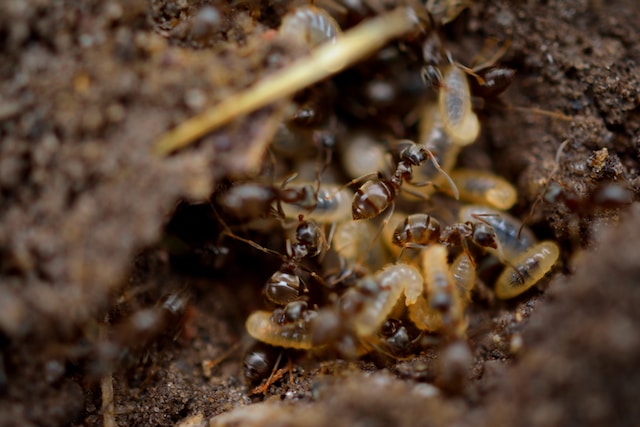
If you see any signs of termite activity, consult a qualified pest control professional to confirm the problem and recommend a proper treatment. Some of the most effective preventive treatments are soil-applied chemicals.
Some of these chemicals, such as fipronil (Taurus SC), are non-repellent. They work by poisoning the termites that come in contact with them and then carrying the termiticide back to other termites in the colony.
Liquid Soil Treatment
Liquid soil treatment is one of the most effective methods for eradicating termites. It involves digging a trench around the foundation of a home and injecting it with non-repellent termiticide that suffocates foraging termites when they come into contact with it.
The trenching must be done by a professional using established techniques to complete the barrier around the property. The technician will also know how far apart to space the holes and how to cover them afterward, leaving little to no visual indication that drilling ever occurred.
This termite soil treatment Colombus OH is ideal for homes in flat blocks prone to flooding. However, it is inappropriate for sloped blocks because the termiticide can wash away when rain occurs, rendering the treatment ineffective. Moreover, the product is less effective than bait stations or physical barriers.
Bait Stations
Termite bait stations offer a safe alternative to traditional pesticide treatments for termites. They contain low doses of slow-acting, non-repellent chemicals impregnated into wood and used as a lure to control the termite population.
These traps are designed to be tamper-resistant so that children or pets cannot access them and can be placed around the home or yard as needed. They are typically secured to the ground, a heavy patio stone or wall, so they can’t be shaken loose or destroyed by hoofed livestock or wildlife.
Some of the chemicals in these traps include hexaflumuron, chlorofluazuron and noviflumuron, which effectively kill termites. The baits also utilize orange oil that dissolves the termites’ exoskeletons and causes them to dehydrate, die or become disoriented and leave the area.
Physical Barriers
A physical barrier is a great way to keep termites away from your home. It can be placed around the foundation or the entire perimeter of the yard. Physical barriers are especially effective in combination with chemical treatments.
A popular type of physical barrier is the particle barrier. It consists of uniform-size particles that prevent termites from tunneling through them. This material has been used in homes to protect piers, slab leave-outs and expansion joints. It has also been successful when placed in bath trap areas and around plumbing penetrations.
Although these types of barriers are effective, they require regular reapplication. They will degrade in the soil over time, so using them as part of an integrated pest management strategy is important.
Boric Acid
Boric acid is a powerful termite soil treatment that can prevent or destroy a home’s termite problem. It’s easy to find in most hardware and grocery stores as sodium borate powder or borax. This powder can be sprinkled around the exterior of a house or mixed with water to create a spray and administered to areas like baseboards, cabinets, closets, stoves, refrigerators, electrical power outlets, drain pipes, cracks and crevices, and fissures.
It can also be applied as a wood preservative and pesticide. The chemical dehydrates the pests, effectively starving them. It’s important to follow safety precautions when using boric acid and other soil treatments, as inhaling or ingesting it can be harmful.
Vinegar
Vinegar is a common household ingredient that can help repel many types of insects. It can be used in various pest control methods, including spraying around the home to keep ants and mosquitoes away. For other pests like fruit flies, vinegar can be used in simple at-home traps to kill them.
Diatomaceous earth (DE) is another option that can be added to soil to dehydrate and kill termites. It also helps reduce moisture in a building, which is one of the main factors that lead to termite infestations. Adding DE to soil around the house or to wood piles can help prevent termites from entering structures. Similarly, using a fungus-like Metarhizium anisopliae as part of the pretreatment of construction materials can also prevent termites from attacking.